
 Grand Lodge of IdahoA.F. & A.M.
The History of Freemasonry in Idaho
From Idaho Territory to the present day.
On this page
GRAND LODGE OF IDAHO TERRITORY
THE BEGINNING
By Jerry D. Parsons, Grand Historian (2013–2016; 2017–2018)
The Idaho Territory was created in 1863 when President Abraham Lincoln signed the bill that created it. By then, there were many who had traveled to and through this mountainous and desert area.
Gold was discovered in the Boise Basin in 1862 and in the Owyhee Mountains thereafter. Among the many who ventured to the gold fields were Masons who populated new towns and cities to search for wealth. Boise City became a supply city for the gold towns of Idaho City (originally known as Bannock), Placerville,
Pioneerville, Centerville, Silver City and others that went by the wayside when the gold was depleted.
The Masons in Idaho City petitioned the Grand Lodge of Oregon for a dispensation to hold meetings in the bustling town of Idaho City. That dispensation was granted in 1863 with them becoming the first Masonic Lodge in Idaho still in existence. (There was anearlier Lodge formed in Lewiston but was short lived).
As the towns increased in population, Masonic Lodges were given dispensations to meet from the Grand Lodges of Oregon and Washington. Among them, Boise #37 and Placer #38 began meeting early in 1865.
The Brethren in Placerville saw a need for forming the Grand Lodge of Idaho Territory and corresponded with Idaho Lodge #35 and Boise Lodge #37 in June of 1865 to meet in Idaho City for the consideration of forming a Grand Lodge. With only three Lodges and 88 members, this meeting was not held.
In the next two years, Masonic Lodges were formed in Pioneerville (Boise Basin) and Silver City (Owyhee mountains). That brought together six Lodges that could form and sustain a Grand Lodge of Idaho Territory.
In June of 1867, Placer #38 again corresponded with the Lodges of Idaho Territory and requested them to send committees to Idaho City to meet and consider
the formation of a Grand Lodge of Idaho Territory. Committees were formed by Placer #38, Idaho #35, Pioneerville #12 (Washington), Boise #37 and Owyhee Lodge UD who agreed to meet in Idaho City on December 16, 1867. On December 17, 1867 the Grand Lodge of Idaho Territory was officially formed. They agreed to meet again in June of 1868 as a Grand Lodge and to approve a Constitution and By Laws and charter Lodges. They installed the Grand Lodge officers in July of that year which was led by Worshipful Brother George H. Coe, Idaho’s first Grand Master.
The original Masonic Lodge building in Idaho City was consumed by fire on May 18, 1865, when the city burned. The Masons of Idaho City rebuilt a Masonic
Lodge building and occupied it in September of 1865. It was a block from the original site and that building still stands and functions as a Masonic meeting
place. This building is historically known as the oldest Masonic Hall, where a Grand Lodge was formed and where they met in the years after, that still exists west of the Mississippi River.
The Lodges chartered in June of 1868 were Idaho #1, Boise #2, Placer #3, Pioneerville #4, Owyhee #5 and War Eagle #6. Pioneer #4 had their charter arrested in 1878. Owyhee #5 and War Eagle #6 consolidated in 1881 to form Silver City #13.
Since that time, the Grand Lodge of Idaho has expanded to its current 52 Lodges, Idaho Lodge of Research #1965 and two Historic Lodges; Idaho City Historic Lodge #1863 and Murray Historic Lodge #1886.
Explore Our Heritage
Grand Lodge Proceedings →
Past Grand Masters →
Grand Lodge Officers →

Idaho City Masonic Hall · Duane Garrett, 1976 · HABS / Library of Congress. Photo source.
Visit a Lodge
Discover Idaho’s living Masonic community through the GrandView public Lodge Locator.
A History of Freemasonry in Idaho
Brother Jerry D. Parsons’s account above traces the organization of Idaho’s early lodges and the formation of the Grand Lodge. The history that follows begins with the communities those Brothers served: mining camps, river towns, railroad centers and agricultural valleys. Across these places, lodge life depended on members who maintained meetings, taught their successors and helped one another through changes in work and population.1
Idaho City: keeping the early history within reach
Idaho City’s surviving hall remains a physical connection to the people in Brother Parsons’s account. Boise County’s history records that the lodge Bible and charter were rescued from the 1865 fire and kept in the replacement hall. It also notes that Idaho Lodge No. 1 later moved its meetings to Boise in the 1920s while retaining occasional use of the Idaho City building. The hall and its records therefore tell a story of continued association after the mining boom, as well as the founding events described above. The Library of Congress/HABS photograph retained on this page documents that surviving setting.9

Brotherhood in the mining communities
The early lodges offered practical assistance alongside their ceremonies. The Idaho State Historical Society’s account of Masonry in mining towns describes social gatherings, Masonic funerals and help during financial hardship. For men who moved between mining districts, a lodge provided a familiar association and people to turn to. The fraternity’s influence in those communities came through relationships maintained over meetings, visits and shared responsibilities.2
Northern Idaho and the Coeur d’Alene mining district

Masonry’s expansion continued in the northern mining districts. The National Register nomination dates Murray’s Masonic hall to approximately 1884–1886, following the 1883–1884 gold rush into the Murray–Eagle area of the Coeur d’Alene district. Its 1987 survey describes the upstairs room used by Coeur d’Alene Lodge No. 20, with its officers’ stations, seating and kerosene lamps. Read alongside the nomination’s account of funerals, social gatherings and mutual support, the room records the ordinary work of maintaining a fraternity in a mobile mining population.2


Silver City: Masonry in the Owyhees
Silver City’s Masonic history began among the Owyhee mining communities. Owyhee Lodge No. 5 and War Eagle Lodge No. 6 were among the lodges chartered by Idaho’s new Grand Lodge in 1868. Brother Parsons records their consolidation in 1881 as Silver City Lodge No. 13. Keeping that history in view helps explain the 1881 inscription on the surviving hall: it commemorates the consolidated lodge, rather than establishing when every part of the building was erected.1, 11
Silver City’s Lodge Heritage
Silver City Lodge No. 13
Homedale · Owyhee County
Silver City Lodge No. 13 carries its Owyhee mining-district heritage into its present home in Homedale. The photograph shows the historic hall in Silver City, a different place from the lodge’s regular meeting location today.

The historic hall across Jordan Creek had an earlier life as a planing mill with a social room upstairs, associated with mill owner Tom Jones. Preservation Idaho records a Masonic purchase in the mid-1870s and remodeling in 1892. The Owyhee Avalanche’s later interviews identify the purchasers as Royal Arch Masons. The surviving accounts do not establish one certain construction date.10, 11
- 1868: Owyhee Lodge No. 5 and War Eagle Lodge No. 6 were among the new Grand Lodge’s chartered lodges.
- 1881: Those two lodges consolidated as Silver City Lodge No. 13.
- 1949: Silver City Lodge No. 13 moved its regular meetings to Homedale; its first meeting there was held August 13.11
- 1957: The lodge began using the West Idaho Avenue meeting room described in the 2023 local history report.
The 2023 account also records Owyhee and War Eagle ceremonial jewels still used in Homedale, preserving a tangible connection with the predecessor lodges.
Historical sources: Brother Jerry D. Parsons’s Grand Lodge account; Preservation Idaho; The Owyhee Avalanche, July 5, 2023, p. 10. Present location: GrandView public lodge record.
Beyond the lodge room, the Owyhee Avalanche’s 2023 report records scholarships, a school reading incentive and highway cleanup. These activities continue the lodge’s community service in Homedale.11
Boise and Lewiston: lodges in growing towns
Lodges also assisted public life in more direct, everyday ways. The territorial legislature met in a Masonic hall in Boise in 1868, with the Council upstairs and the Assembly below. In 1874 the Council again used a Masonic hall. These arrangements are recorded in the Idaho State Historical Society’s account of the legislature’s meeting places.5
As Boise grew, its Masons developed a substantial downtown institutional presence. Preservation Idaho describes the temple at 215 North 10th Street, its design by Ross Cartee and its recognition as a city historic landmark in 2012. Earlier meeting places and the later temple belong to successive stages of lodge life in the capital: members’ shared rooms became part of a larger urban network of businesses, public institutions and voluntary associations.13
Lewiston’s history also extends beyond the short-lived early lodge mentioned by Brother Parsons. Nez Perce Lodge No. 10 built the Masonic Temple at 855 Main Street in 1904. The city’s Historic Preservation Commission describes a theater on the ground floor, a banquet room above it and lodge rooms and a library on the third floor. Its cultural history includes touring performers and later films, boxing and wrestling. A lodge building could serve its members’ meetings while also providing public entertainment and gathering space for a river town.12
Southeastern Idaho: railroad communities and agricultural valleys
In southeastern Idaho, lodge development accompanied transportation and settlement beyond the original mining districts. Arthur C. Saunders’s 1915 history of Bannock County records the organization of Portneuf Lodge No. 18 in Pocatello in 1886. Its first meeting place was a multipurpose frame building that also served, at different times, churches, schools, the fire department and the city council. The setting was a railroad community in which organizations shared scarce rooms while the town grew.14
Pocatello’s municipal history connects the railroad junction with later commercial development and irrigated agriculture. The Grand Lodge’s 2022–2023 directory places Portneuf in Pocatello, Eagle Rock No. 19 in Idaho Falls and Grove City No. 33 in Blackfoot. Those records show the Craft established across the region’s towns, rather than confined to the earlier gold camps. They also help place lodge history within the changing economy of the Snake River valleys, without assuming that every lodge followed the same path or had the same membership.15, 16
Hailey and the Wood River Valley
Later lodge histories show the fraternity becoming established in other Idaho communities. Hailey’s members received a dispensation in September 1884 and a charter as Hailey Lodge No. 16 in September 1885. Its membership continued to grow, reaching 250 in the 1950s, according to the lodge history documented in its National Register nomination.3
The local record also preserves cooperation in difficult years. After a fire destroyed Hailey’s furnishings, equipment, charter and records in 1927, the Odd Fellows offered meeting space and Richfield’s Masons loaned equipment for the next meeting. The lodge continued because members and neighboring organizations helped it carry on.3
Community work became a continuing part of local lodge life. Hailey’s Masons and Odd Fellows jointly created a picnic ground at Prairie Creek in 1930. The lodge’s history, written in 2008, also records scholarships for high-school graduates, highway cleanup and support for local heritage activities. Brother John M. “Jack” Rutter, a Hailey Mason from 1924, served on the city council, as mayor and on the county hospital board. Such local records preserve the work of members whose service extended well beyond Masonic office.3
Masons in Idaho’s public life

MWPGM George Laird Shoup served as Grand Master of Idaho, as recorded by the George Washington Masonic National Memorial. He also helped establish Salmon, served in the territorial legislature and became Idaho’s last territorial governor and first state governor. His service in the United States Senate ran from 1890 to 1901. His career placed a lodge leader among the men shaping Idaho’s transition from territory to state.4
MWPGM James Alonzo Pinney (1835–1914)

Born in Worthington, Ohio, MWPGM James Alonzo Pinney (1835–1914) grew up in Iowa and became a Master Mason in Iowa City Lodge No. 4 in May 1859. He reached Idaho City in 1863 and became a charter member of Idaho Lodge No. 1, where he served as Junior and Senior Warden.17, 18
MWPGM Pinney worked as a merchant and postmaster in Idaho City before moving to Boise in 1872 and opening a book and stationery business. He affiliated with Boise Lodge No. 2 in 1881, served as its Master and was elected Grand Master of Idaho in 1893. He later helped organize Idaho’s Grand Chapter of Royal Arch Masons in 1908 and became its first Grand High Priest.18
As a Boise mayor, he also helped develop the city’s public services. The City of Boise’s historical account credits his administrations with a municipal fire station, the purchase of toll bridges and removal of their tolls, and the first ten miles of a sewer system. His Columbia and Pinney theatres contributed to Boise’s cultural life. His record follows one Brother from a charter lodge in a mining town into the leadership of both Idaho’s Masonic institutions and its growing capital.19
From local lodges to a statewide institution
The Grand Lodge’s directory provides a later view of that geographic reach. Its 2022–2023 list includes lodges in the northern communities of Bonners Ferry and Sandpoint, in Grangeville and Lewiston, in Boise and the southwestern valleys, in the Magic Valley and across eastern Idaho. It is a dated record of a statewide organization, not a claim that the number or location of lodges has remained fixed. The movement, consolidation and survival of individual lodges form part of that larger institutional history.16
Alongside these local stories, the Grand Lodge’s proceedings record decisions on relief, education and fraternal relations. The episodes that follow trace that work from the first years of the territorial Grand Lodge into the present century.
A permanent commitment to relief: the Orphans’ Fund, 1869

In 1869, only two years after its organization, the Grand Lodge established a permanent fund for the support and education of the children of deceased or indigent Masons. The unanimously adopted resolutions required subordinate lodges to collect one dollar annually from their members and from unaffiliated Masons living within their lodge limits. The principal was to remain intact; interest could be used for the stated relief. The Grand Master and Grand Wardens served as trustees, with an obligation to report annually.23
The fund’s early survival required a further decision. In 1871, the Grand Lodge adopted a Finance Committee report opposing a proposal to abolish the Orphans’ Fund and transfer its money to the Representative Fund. By retaining the separate fund, the delegates preserved money set aside for children’s support and education. These proceedings show how the young Grand Lodge made charitable responsibility part of its finances and governance.23
Past Grand Masters together, 1897
In this studio photograph, dated September 14, 1897, eight Past Grand Masters appear together, nearly thirty years after the Grand Lodge was formed. MWPGM Jonas W. Brown had first served in 1869–1870; MWPGM Fred G. Mock’s term was 1896–1897. Their years of leadership span Idaho’s territorial period and its first years of statehood. Preserved by the Idaho State Archives, the photograph puts faces to that passage of time and brings several of the Brothers discussed in this history into the same frame.41

Our Past Grand Masters portrait collection includes individual portraits and service years for all eight Brothers.
Gatherings and instruction, 1897–1907
The Idaho State Archives preserves wider views of the fraternity as well as individual portraits. Photographs of Grand Lodge members in Boise in 1897 and 1899 record the assembled membership and officers, while two School of Instruction groups document another setting for Masonic education. The Archives catalogs both instruction photographs within the broader range 1897–1907. Together, these pictures bring more of the Brothers who sustained the organization into the historical record.42


Relief beyond Idaho: the California earthquake, 1906
The earthquake and fire in California in April 1906 brought an appeal that reached Idaho’s lodges. At the September Annual Communication, the Grand Master reported that constituent lodges had already responded and asked the Grand Lodge to contribute as well. On September 13, the delegates adopted a financial report recommending five hundred dollars from the General Fund for distressed Masons and their families.24
The following year’s Proceedings confirm that the contribution was sent. On September 29, 1906, Idaho’s Grand Master transmitted the five hundred dollars to California’s Grand Master for earthquake and fire relief. The record preserves a practical example of assistance passing between Grand Lodges when a disaster overwhelmed communities beyond their own jurisdictions.24

Idaho Masonry during the First World War

During the First World War, the Grand Lodge’s records show both financial participation and attention to members in uniform. The Orphan Fund trustees’ 1918 report records $23,014.87 spent on United States Liberty Loan Bonds, alongside $2,600 for relief of indigent Masons, widows and orphans. The report also explains the separation of the permanent principal from the interest or usable fund so that the original charitable endowment could be kept intact.26
The Grand Secretary reported issuing about twenty Grand Lodge certificates to soldiers without the usual fee. The same volume printed a Roll of Honour, identifying Idaho Masons serving at the front and arranging their names by lodge. These entries preserve the connection between military service and the local lodge communities to which the men belonged.26
Keeping the fraternity together through influenza, 1918–1919

The influenza epidemic interrupted Idaho lodge life during the closing months of 1918 and the following year. The 1919 Proceedings state that local and state health regulations prevented lodges from meeting. After those restrictions were lifted, the Grand Master’s dispensations allowed affected lodges to elect and install officers beyond the normal deadlines. The Grand Lodge adopted a Jurisprudence Committee report accepting those delayed elections as justified by the emergency.27
The epidemic also touched the Grand Lodge’s leadership. Its memorial account records that MWPGM Andrew Lounsbury was unable to visit lodges during the first half of his term because of the epidemic. He later contracted influenza; according to the contemporary account, the illness weakened his heart. He died on June 16, 1919. MWPGM Arch Cunningham, then Deputy Grand Master, convened an Emergent Communication at Albion for the Grand Lodge’s part in his funeral observances.27
Masonry and public education: Moscow, 1924
On September 17, 1924, the Grand Lodge of Idaho participated in the laying of the cornerstone of Science Hall at the University of Idaho in Moscow. The university’s student newspaper placed the ceremony within the opening exercises of the academic year. Its published program called for University President A. H. Upham to request the laying of the cornerstone, followed by a procession led by the university band from the auditorium to the new building, where faculty, students and visitors would witness the Masonic ceremony.22
Two photographs in the University of Idaho’s archives preserve the gathering: dignitaries in Masonic regalia on the dais and a long procession crossing the campus beside Science Hall under construction. The dais photograph is cataloged under the name of MWPGM Isaac C. Hattabaugh. Together, the images document Idaho Masonry taking part in a public university occasion, bringing lodge traditions into view of the wider community.20, 21


Faith and public trust in a time of crisis, 1933
Research leads: Brother Chris E. Wethered, Grand Historian (2020–2021).43
In his 1933 address, “Masonry and the Crisis of Today,” the Reverend Brother Ernest F. Harold urged Masons to put their principles into practice amid economic and social disruption. He argued that an institution’s age and past achievements could not guarantee its future. Its members had to make Brotherly Love, Relief and Truth visible in their own conduct.44
Brother Harold called for renewed confidence in public life and business, warning against narrow nationalism, racial prejudice and exploitation. His discussion of employment, fair dealing and the responsibilities of leadership placed the fraternity’s moral teachings alongside the urgent problems its members encountered outside the lodge room.44
Idaho Night in New York, since 1937
Research leads: Brother Chris E. Wethered, Grand Historian (2020–2021).43
In 1937, Brother W. G. Briggs, New York’s Grand Representative for Idaho, arranged a visit by Idaho’s Grand Master. The March 5 rededication ceremony at Fiat Lux Lodge No. 1079 was also designated Idaho Night, and the visitor conveyed the fraternal greetings of Idaho’s Masons.45
The 1938 and 1939 Proceedings record further visits, including a program of Idaho scenes and “Prairie Schooner,” a song dedicated to Idaho Masons with music credited to Brother Irving Berlin. In 1940, Idaho’s Grand Master described Idaho Night as a developing tradition and credited Brother Briggs with starting it.46, 47, 48
The tradition continues. The 2025 and 2026 photographs below document later Idaho gatherings at James W. Husted–Fiat Lux Lodge No. 1068 in New York.50, 59


Support for persecuted brethren in Europe, 1938
Research leads: Brother Chris E. Wethered, Grand Historian (2020–2021).43
In 1938, the Grand Lodge of Idaho responded to an appeal from the Masonic Service Association on behalf of Austrian Masons forced from their homes. The appeal described 300 Viennese brethren whose property had been confiscated and who had been ordered to leave Austria. The Swiss Grand Lodge Alpina had organized assistance but needed support from other jurisdictions. Idaho’s Grand Master reported that Idaho was among the first to respond and that its contribution formed part of the initial relief sent to Switzerland.46
The response was moral as well as practical. In an appendix to the same volume, Grand Secretary Curtis F. Pike condemned the persecution of both Freemasons and Jews. He distinguished tolerance from indifference, arguing that a demand for freedom of mind and conscience carried a duty to demand those freedoms for others. These passages record Idaho Masons confronting the persecution in Europe through relief and through an appeal to the fraternity’s own principles.46
A declaration of principles as war approached, 1939
Research leads: Brother Chris E. Wethered, Grand Historian (2020–2021).43
At the Grand Masters’ Conference in Washington in February 1939, Masonic leaders considered how to state the fraternity’s purposes amid an international crisis. MWPGM Clyde I. Rush, then Idaho’s Grand Master, brought the resulting Declaration of Principles before the Grand Lodge. It described charity, education, belief in God, personal responsibility and liberty of conscience, while distinguishing the individual Mason’s civic judgment from political action by Masonic bodies.47
On September 14, Idaho’s delegates adopted the Jurisprudence Committee’s report approving the recommendation, with a specific qualification: the declaration was to be used for the education of the Craft, with publication limited to its appearance in the Grand Master’s address. The record therefore preserves both the statement and the limits Idaho placed on its use in 1939.47
The same communication heard Brother Marcus J. Ware’s address, “Freemasonry and the World of Tomorrow.” With war already underway in Europe, the Grand Orator defended freedom of conscience and democratic institutions against the dictatorships of Hitler and Stalin. He urged Masons to apply their teachings in life rather than leave them as subjects for contemplation alone.47
Encouragement for Britain and democratic citizenship, 1940–1941
Research leads: Brother Chris E. Wethered, Grand Historian (2020–2021).43

At its September 1940 communication in Lewiston, the Grand Lodge adopted a cablegram of greetings and sympathy to the Masons of the British Empire. Signed by the Grand Master and Grand Secretary, it expressed hope for their success against despotism and recognized their struggle as one involving principles dear to Freemasonry.48
The Jurisprudence Committee submitted the resolution during the annual session. Its adopted wording called for the message to bear the signatures of the Grand Master and Grand Secretary, and addressed it to England’s Grand Secretary at the Masonic Peace Memorial Temple on Great Queen Street in London. The cable also invoked the Great Architect of the Universe and pledged the prayers of Idaho’s brethren.48
The Proceedings also print the reply from England’s Grand Secretary, Sidney A. White, dated September 14. He acknowledged Idaho’s message and described the encouragement that such fraternal support brought.48
The letter was written from Freemasons’ Hall in Great Queen Street, London. White described worldwide Masonic support as a source of comfort and encouragement as British brethren faced the dangers around them. He also asked that his Grand Lodge’s fraternal greetings be conveyed to Idaho’s Grand Master and the members of his jurisdiction. A note in the Proceedings records its receipt in Idaho on October 11, preserving the distinction between the letter’s September date and its later arrival.48

In 1941, the Grand Master reported that he had chosen Masonic Citizenship as his theme for the year and expressed sympathy for brethren overseas. Brother Raymond H. Snyder’s Grand Orator address, “Democracy and Masonry,” asked what Masons could contribute to making democratic government work. His answer included informed participation, service on city councils and school boards, and a willingness to accept civic responsibilities even when doing so was uncomfortable. The volume’s foreign-correspondence report also preserved an account of the suppression of European Grand Lodges. Together, these records show international concern and local citizenship becoming connected subjects of Idaho Masonic discussion.49
Wartime service at Farragut, 1944–1947

Idaho’s response to World War II took practical form on September 3, 1944, when the Masonic Service Association opened its eightieth service center at Farragut Naval Training Center. Nearby lodges and Order of the Eastern Star chapters helped operate it. Grand Master George E. Bacheller emphasized that the work served members of the armed forces regardless of creed or membership in a fraternal organization.51
By 1945, improvements had more than doubled the building’s capacity. Grand Master Gilford H. Mayes authorized Pend d’Oreille Lodge, U.D., to meet in the addition so that hospitalized and convalescent Masons, as well as members of the base’s ship’s company, could attend lodge without traveling away from Farragut.52
Its dispensation was surrendered in February 1947. Furniture and regalia then helped Kuna Lodge No. 79 recover from a fire, with the remainder going to Rathdrum Lodge No. 41.52
Relief in a recovering world, 1946–1947
The end of the war redirected relief work toward recovery. In 1946, the Grand Master reported that Idaho had contributed from its Masonic Welfare Fund to the European Masonic Relief Fund following the Masonic Service Association’s investigation of conditions in Europe. The Grand Lodge approved the contribution. The following year, its welfare committee urged continued support for hospital visitation after the wartime service centers had closed. These records show relief work continuing beyond the immediate wartime emergency.54
New lodge homes across Idaho, 1948–1950
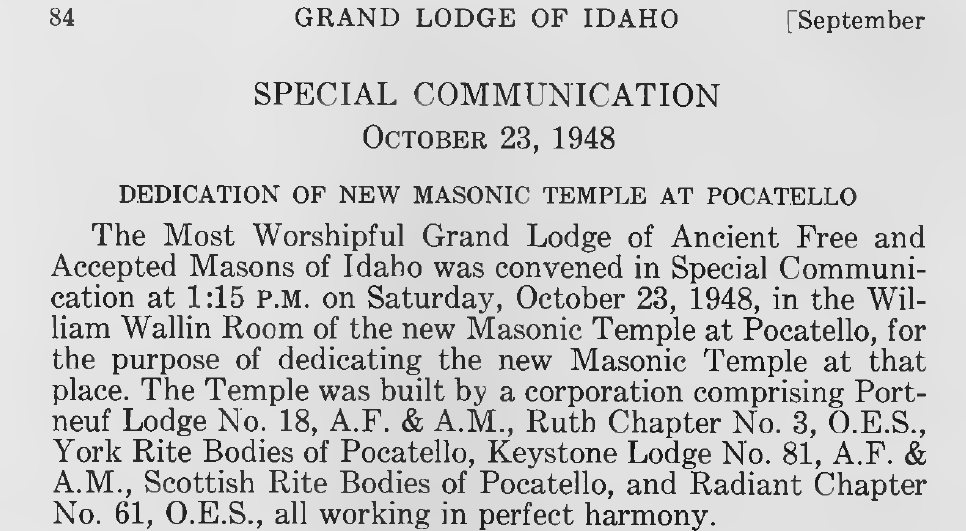
The new Pocatello Masonic Temple was dedicated on October 23, 1948. Its construction brought together Portneuf Lodge No. 18, Keystone Lodge No. 81, the local York and Scottish Rite bodies, and Ruth and Radiant chapters of the Order of the Eastern Star.55
The formal minutes record 220 Master Masons at the dedication. A procession entered the new main lodge room, where Grand Lodge officers dedicated the hall with corn, wine and oil. A male quartet led by Brother Rudolph F. Goranson, Past Master of Keystone Lodge No. 81, provided the music. That evening, Ruth Chapter No. 3 served a banquet in the Temple dining room, with Governor Charles A. Robins, then Grand Orator, as the speaker.55
New temples at Filer and Cascade were dedicated in December 1948 and July 1949. Sandpoint and Caldwell followed in 1950, when the Grand Lodge dedicated the homes of Lakeside Lodge No. 42 and Mt. Moriah Lodge No. 39. 55

Learning across lodge boundaries, 1954–1955
Masonic education became a reason for lodges to visit one another. Grand Master Angus Y. Bethune proposed that each lodge prepare an educational presentation and take it to the other lodges in its district. Reporting on the program in 1955, his successor, Larry W. Brainard, acknowledged that participation had fallen short of the full schedule but described many visits with well-prepared, informative programs. He saw a double benefit: the presenters learned through their own study and research, while the visits created new acquaintances and fellowship. He recommended continuing the exchange.56
Public schools and a public library, 1961

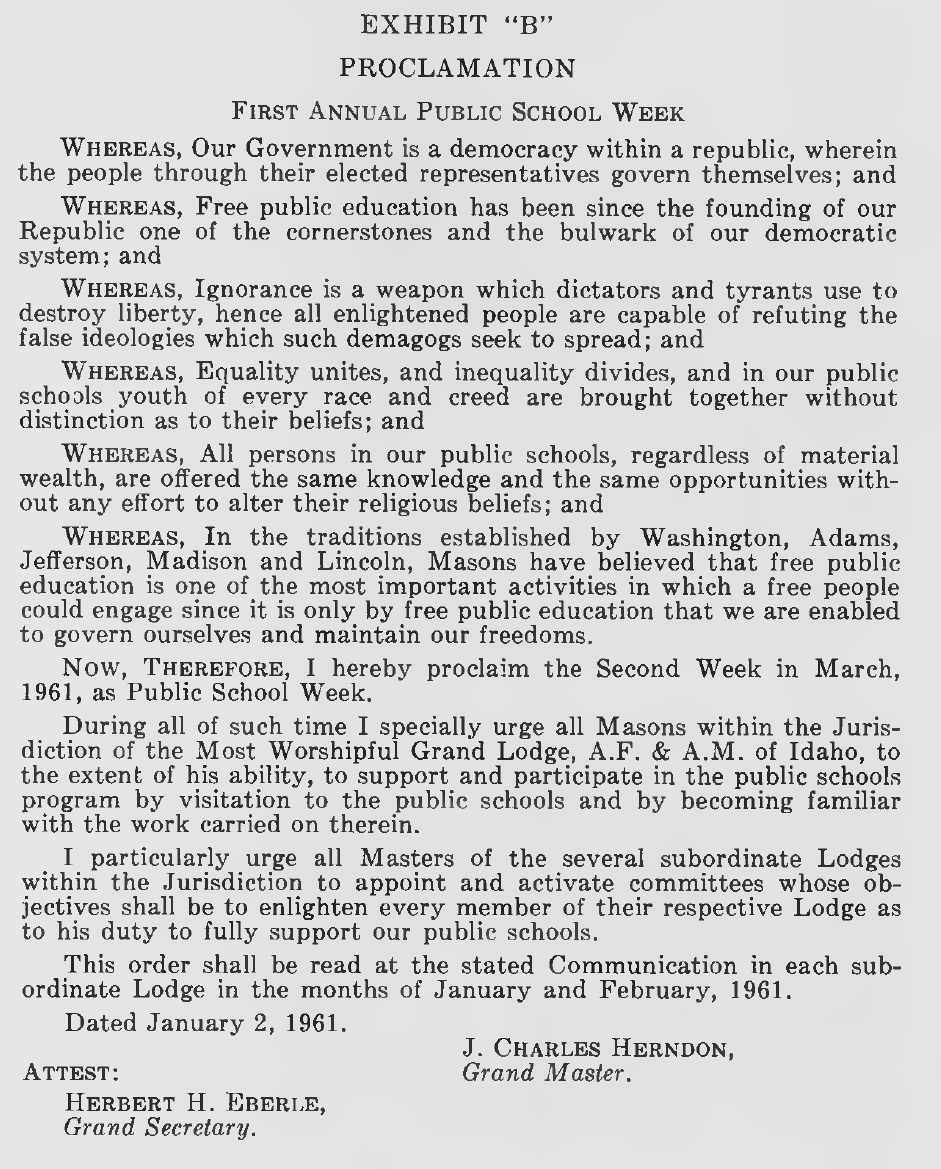
On January 2, 1961, MWPGM John Charles Herndon, then Grand Master of Idaho, proclaimed Idaho Masonry’s first annual Public School Week for the second week in March. He urged Masons to visit schools, become familiar with their work, and form lodge committees to support public education. The year’s committee report recorded observances in 34 of the 66 lodges that answered its questionnaire. Thirty responding lodges had presented 145 teacher appreciation certificates, recognizing a combined 2,346 years of service in public schools.57
That same year, the Grand Lodge laid the cornerstone of Pocatello’s new Public Library on August 15. The recorded ceremony describes a procession from the Masonic Temple to the library site. Speaking at the ceremony, MWPGM Clyde I. Rush connected its symbolism with the library’s purpose of making useful knowledge available to everyone who wished to use it.58
Contemporary newspaper coverage records the civic voices at the ceremony as well. City commission chairman Luvern Johnson described libraries as essential resources for education and a free society. Library board chairman Roy F. Miller opened the program, and Jared Anderson related the history of the site.60
A lodge devoted to Masonic research, 1965
The Grand Lodge gave organized Masonic study a further place in its work by chartering the Idaho Lodge of Research No. 1965 in September 1965. Its 1966 Proceedings record the formal constitution of the lodge in December 1965, with Norvell D. Parks as its first listed Worshipful Master.28
The Idaho Lodge of Research No. 1965 (GrandView profile) gives Masonic education a dedicated home. Its stated purpose includes collecting and sharing material on Masonic history, symbolism, philosophy and the responsibilities of Master Masons. Its library includes Idaho documents and historical photographs, and its meetings provide another way for members around the state to study the Craft.7
A hundred years of Idaho Masonry: the centennial, 1967

The centennial observances brought Masons and their families together for worship, history and fellowship. A Thanksgiving service at Boise’s Cathedral of the Rockies on September 18 included a sermon by Brother the Reverend Herbert E. Richards. The Idaho Lodge of Research No. 1965 hosted the reception afterward, honoring MWPGM Arthur L. Dingler, then Grand Master, and his wife.36
On September 20, about 250 Masons and family members traveled in five buses and private cars to Idaho City. They visited the hall where the Grand Lodge had been formed, along with the museum, pioneer cemetery and other historic places. Guides described sights along the route, and the group returned to Boise that afternoon. The excursion made the founding community part of the centennial experience.36
The celebrations also drew on Boise’s cultural life. The Grand Lodge banquet at Capital High School featured the Oinkari Basque Dancers, music by the Wehr family and an address by MWPGM John J. Murchison of Oregon. A variety night at El Korah Shrine included barbershop singing, band performances and old-time fiddlers.36
A later generation marked the Grand Lodge’s centennial in 1967 with a commemorative publication for gatherings in Boise and Idaho City. The Idaho State Archives holds that illustrated centennial volume, preserving a record of how Idaho Masons remembered their first hundred years.6
Relief after the Teton Dam disaster, 1976

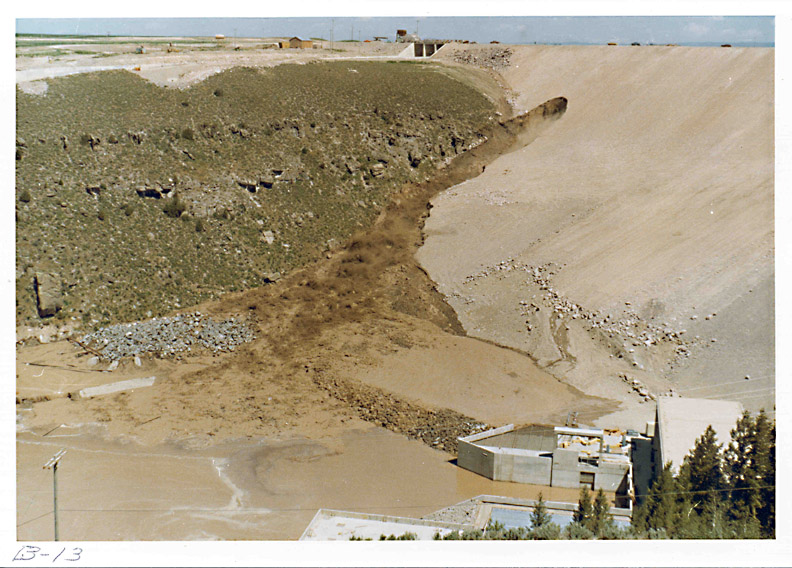
When Teton Dam failed on June 5, 1976, flooding devastated communities in eastern Idaho. The Grand Lodge’s response appears in its records that same year. On June 22, after consulting the Masonic Relief Fund trustees, the Grand Master authorized fifteen thousand dollars for immediate assistance to distressed Brothers and their families. He appointed a local committee to assess needs and distribute the funds.29
The financial accounts show the relief work underway. For the year ending July 31, 1976, the Grand Lodge recorded $7,100 in Teton Dam disaster-relief expenses. Its Grand Master also recommended that officers continue checking on affected members and their families to determine what help they needed. The authorization, expenditure and follow-up together document the Grand Lodge’s practical response to one of Idaho’s major disasters.29
Full fraternal recognition of Prince Hall Masonry, 1991

At its September 1991 Annual Communication, the Grand Lodge adopted a report granting full Masonic recognition to the Most Worshipful Prince Hall Grand Lodge F. & A.M. of Oregon, Inc., which also had lodges in Idaho. A special committee had spent the preceding year studying Prince Hall history and Masonic regularity and meeting with representatives of that Grand Lodge. The Prince Hall Grand Lodge had already approved reciprocal recognition at its June 1991 communication, subject to Idaho taking corresponding action.31
The adopted report affirmed shared Masonic principles and extended the rights customarily associated with fraternal recognition. It expressly preserved each Grand Lodge’s authority over its own lodges and membership. Both remained self-governing, with their own Grand Master, rules and regulations.31
Preserving a lodge room in Rupert, 1994

On August 20, 1994, the Grand Lodge dedicated a Masonic museum at the Minidoka County Museum in Rupert. Brother Dale C. Stoller, District Deputy Grand Master of the Fourth District, and Rupert Lodge No. 65 arranged the occasion in response to the city’s invitation. MWPGM James A. Davidson, then Grand Master of Idaho, opened a Special Communication in the Rupert temple before the officers and brethren proceeded to the county fairgrounds for the public ceremony.62
The new display recreated a Masonic lodge room with furnishings from a lodge that had ceased operating. Brother Stoller explained both the exhibit’s purpose and Masonry’s place in Rupert’s history. The Grand Master and his officers performed the dedication, and Brother Kent W. Gist, Grand Orator, delivered an address. The brethren then toured the museum. The preserved furnishings gave visitors a way to see the setting of lodge life alongside the community’s other historical collections.62
Relief after September 11, 2001
The September 2001 Annual Communication met in the immediate aftermath of the attacks on New York and Washington. MWPGM John W. Sharp, then Grand Master, offered a tribute to the country and called for silence. The Grand Chaplain prayed for those who had died, their families, the rescue workers and the nation’s leaders. The tragedy also prompted a practical response: the delegates approved relief through the Masonic Service Association.63
The Grand Lodge kept the combined contribution open until November 1 so that Idaho’s lodges and individual brethren could add their support. The following year’s Grand Secretary’s report confirms that those additional gifts were received and that the combined contribution was mailed to the Association on November 1, 2001. It also records further contributions sent directly by lodges and individuals after that date.63

Read together, the two annual volumes show the response moving from remembrance and an authorized contribution to a wider effort among Idaho’s Masons. Relief beyond the state’s borders remained part of the fraternity’s work as it entered the twenty-first century.63
Responding to Hurricanes Katrina and Rita, 2005

On September 27, 2005, MWPGM James C. Herndon, then Grand Master, ordered the establishment of the Idaho Grand Lodge Hurricane Relief Fund for Masons affected by Hurricanes Katrina and Rita. He placed the relief effort under the Grand Pursuivant, Brother John E. Warner. Brother Brian Zimmerman, then Worshipful Master of Oriental Lodge No. 60, also helped launch fundraising efforts.65
The Grand Master’s report in the 2006 Proceedings records contributions from brethren and lodges sent directly to the Masonic Service Association and other organizations supporting hurricane relief. The response brought the Grand Lodge’s organizing role together with local initiative. Alongside assistance to members and families at home, Idaho’s lodges could take part in a broader fraternal response when disaster struck communities far away.65
Idaho’s Masonic story at the state museum, 2008
On May 24, 2008, the Idaho State Historical Museum in Boise opened Brotherhood: Freemasonry’s Mark on Idaho. Lodges across the state supplied artifacts for an exhibition of approximately 3,000 square feet, including a recreated lodge room, regalia, photographs and displays on Masonic and affiliated organizations. Nearly fifty Masons and family members served as volunteer docents, answering visitors’ questions.67

The preparation brought museum researchers into local lodge collections. A February newspaper report documents their visit to Silver City Lodge No. 13 in Homedale, where brethren showed them historic objects for possible inclusion. The accompanying photograph records that work with a Masonic ballot box.68
The exhibition also encouraged preservation. Its report in the Proceedings describes documents being rematted and reframed and museum staff offering guidance on caring for lodge artifacts. The final account records the exhibition continuing through September 17, beyond the August closing date advertised earlier in the year.67
A charitable foundation for Idaho’s children, 2011

The Grand Lodge formed the Idaho Freemason Foundation in 2011 to support children’s education, safety and well-being. The 2011 Proceedings record the establishment of a nonprofit corporation, adoption of bylaws and work toward federal tax-exempt status. The Foundation’s own history identifies a model in which local lodges choose community projects, contribute their resources and seek matching assistance.32
Its published award history shows how that model developed. The 2017 list records one thousand dollars for scholarships and a Bikes for Books reading program; the 2018 list records $3,500 for projects including reading incentives, scholarships and food for children. Local knowledge helped direct these grants toward particular community needs.33
The Idaho Freemason Foundation’s 2026 grant list shows how relief and community service continue through local lodges. Projects include school libraries, children’s meals, scholarships, youth programs and assistance to families. The Foundation reports $11,550 in matching grants, representing at least $23,100 in charitable involvement when the local matches are included. Those figures describe the Foundation’s published 2026 grant round, rather than the full extent of Idaho Masonic charity.8
Celebrating 150 years of Idaho Masonry, 2017
The sesquicentennial observances extended across 2017. At the September 21–23 Annual Communication, MWPGM James A. Hensley invited lodges to parade banners prepared for the anniversary and encouraged their use at public events in their communities. Governor C. L. “Butch” Otter’s proclamation designated September 18–24 as Freemason Week. At the September 22 banquet, Brother Jerry D. Parsons, serving as Grand Orator, presented an address tracing the early lodges and the formation of the Grand Lodge.37

On December 17, 2017, the Grand Lodge met in Idaho City’s Masonic hall to mark exactly 150 years since its formation there. In his report the following year, MWPGM William K. Curtis Jr. recalled a program attended by about sixty people, followed by refreshments in Idaho City and an evening banquet in Boise. The anniversary brought the Grand Lodge back to its founding place, fifty years after the centennial visit described above.34
An account published on December 17 by one of the event’s organizers adds that the Grand Master publicly installed the Masters of Idaho Lodge No. 1, Boise Lodge No. 2, Placer Lodge No. 3 and Silver City Lodge No. 13. The writer also describes historical presentations by the Grand Historian and representatives of the lodges at the Boise banquet. These recollections complement the official report by recording how the participants connected the anniversary with the lodges carrying that early history forward.38
The anniversary also produced commemorative objects. A flyer in the Grand Lodge’s February 15 newsletter advertised a quilt incorporating 52 lodge aprons, with a presentation box, for a raffle scheduled at the September 22 banquet. It identified new Grand Lodge officer aprons and cases as the intended use of the proceeds. The flyer preserves one way the anniversary brought the lodges’ identities into a shared work.39


The Idaho World listed “Masons Celebrate Sesquicentennial” in its December 20, 2017 issue, preserving a contemporary local press reference to the celebration. Access to the article may require a publisher login.40
Brotherly care and Grand Lodge business during COVID-19, 2020
On March 17, 2020, MWPGM Steven L. Hall issued an edict suspending attendance at Masonic meetings and gatherings because of COVID-19. The same directive asked each Lodge Master to arrange checks on every member so that Brothers would be safe and cared for. Spring communications were canceled, and the Grand Lodge office adapted by working both in the office and from home.35
The Grand Lodge conducted its 153rd Annual Communication in September through Zoom video conferencing. The Grand Master’s report also records online meetings of the Executive Council, committees and Past Grand Masters, along with regular COVID-19 updates. The Grand Historian’s report compared the disruption with the 1918–1919 influenza epidemic, placing the year’s experience within Idaho Masonry’s longer history of interrupted meetings and continued responsibility for one another.35
Carrying Idaho Masonry forward
Idaho’s Masonic history is still being written in its lodges. The record presented here offers the present generation examples of perseverance, learning and service, along with a responsibility to preserve an honest account of what came before. Charters, minutes, photographs and personal recollections can help future Brothers understand the achievements and the difficulties of those who preceded them.
Preservation depends in part on what today’s Masons choose to record. Identifying people in photographs, retaining the story behind a lodge project and sharing reliable sources can keep important parts of local history from being lost. Each generation can add to this record while welcoming corrections and evidence that make it more complete.
The work ahead is also close to home: welcoming and teaching new Brothers, supporting those in need and building lasting friendships. Idaho Masonry’s future will be shaped by the care its members bring to that work. May those who follow find that we preserved the lessons of our predecessors and put Brotherly Love, Relief and Truth into practice in our own time.
Notes and sources
Numbered references identify the sources listed below and are reused where a source supports more than one passage. Earlier web references were consulted October 17, 2026; subsequent access dates are recorded in individual entries. Historical accounts describe the periods and conditions recorded by their authors.
- Brother Jerry D. Parsons, “Grand Lodge of Idaho Territory: The Beginning,” Grand Lodge of Idaho, undated, original essay preserved above.
- Idaho State Historical Society, “Murray Masonic Hall,” National Register of Historic Places Registration Form, February 17, 1987, section 8. Nomination (PDF).
- Barbara Perry Bauer and Elizabeth Jacox, “Hailey Masonic Lodge,” National Register of Historic Places Registration Form, January 15, 2008, section 8, pages 3–5. Nomination (PDF).
- George Washington Masonic National Memorial Association, “Grand Lodge of Idaho,” July 1, 2023 (Shoup’s Masonic office); Architect of the Capitol, “George Laird Shoup Statue,” undated (civil service and statue). The Memorial summary contains a founding-date discrepancy; this essay follows Brother Parsons for the Grand Lodge’s December 1867 formation. Its service years for MWPGM Shoup also differ from the Grand Lodge’s own historical officer register, which lists him for 1889. See Grand Lodge A.F. & A.M. of Idaho, Proceedings of the 150th Annual Communication (2017), appendix, “Grand Lodge Officers of Idaho (Elective from 1867 to Present),” 150–151, official proceedings (PDF).
- Idaho State Historical Society, Meeting Places of the Territorial Legislature, Reference Series no. 479 (1975), 1–2. Reference Series 479 (PDF).
- Freemasons, Grand Lodge of Idaho, 100 Years, 1867–1967: Centennial of the Grand Lodge of Idaho A.F. & A.M., Boise, Idaho and Idaho City, September 18, 19, 20, 1967 (1967). Idaho State Archives catalog record, 16 pages.
- Idaho Lodge of Research No. 1965, official website, purpose, digital-library description and meeting information, undated.
- Idaho Freemason Foundation, “Idaho Freemason Foundation Announces 2026 Grants,” undated.
- Boise County, “Visit Boise County,” section “Masonic Temple 1865,” undated; Historic American Buildings Survey, “Masonic Temple,” HABS ID-5, historical and descriptive data (PDF), Library of Congress.
- Preservation Idaho, Idaho Architecture Project, “Silver City,” section on the Masonic Hall, undated. The account describes a planing mill and a mid-1870s Masonic purchase; construction-year claims vary among later accounts and are not adopted here.
- “Silver City Masons harken history, look to future,” The Owyhee Avalanche, July 5, 2023, 10, issue PDF. Interviews with lodge members describe the hall and relocation.
- City of Lewiston, Historic Preservation Commission, “Masonic Temple,” 855 Main Street, undated, with archival material credited to the Nez Perce County Historical Society and Museum.
- Preservation Idaho, Idaho Architecture Project, “Masonic Temple,” Boise, undated. The entry gives differing construction-year labels; this essay uses its identification, architect and 2012 landmark recognition without selecting a disputed completion year.
- Arthur C. Saunders, The History of Bannock County, Idaho (Pocatello: Tribune Company, 1915), chapter on Pocatello, transcription. Statements about the building’s uses describe the historical account, not its present condition.
- City of Pocatello, “Pocatello History,” sections “Gateway to the Northwest,” “Permanent Settlements” and “Gold Rush & Agriculture,” undated.
- Grand Lodge A.F. & A.M. of Idaho, Masonic Directory 2022–2023, directory PDF, “Idaho Lodges by City.” Used as a dated jurisdictional record; current meeting arrangements should be checked through GrandView.
- Worthington Libraries and Worthington Historical Society, “James Alonzo Pinney,” Worthington Memory, photograph dated 1895, record whs0637 (WHS 79-G-291), metadata updated July 22, 2026; accessed October 19, 2026. The record identifies Pinney’s birthplace, lifespan and Masonic service, and provides the portrait’s educational-use conditions and required credit. Worthington Historical Society, email to the author, October 20, 2026, supplied the standing scan and an additional seated portrait and expressly permitted website publication with appropriate credit. The seated portrait appears in the Past Grand Masters collection.
- Hiram Taylor French, History of Idaho: A Narrative Account of Its Historical Progress, Its People and Its Principal Interests, vol. 2 (Chicago: Lewis Publishing Company, 1914), 683, biographical entry for James Alonzo Pinney. Digitized volume, New York Public Library copy. Used for lodge affiliations, Masonic offices and business history; the text gives his election as Grand Master in 1893.
- City of Boise, Pioneer Cemetery Walking Tour, 6, “Mayor James A. Pinney,” undated. City publication (PDF). Used for the civic improvements and theatres associated with his mayoral and business career.
- University of Idaho Library Special Collections and Archives, “Science Hall, University of Idaho. Dedication, I.C. Hattabaugh. [67-11],” September 17, 1924, Campus Photographs Collection, PG1_067-11; accessed October 20, 2026. The catalog describes dignitaries on the dais but does not assign names to individual positions. Rights: in copyright, educational use permitted.
- University of Idaho Library Special Collections and Archives, “Science Hall, University of Idaho. Dedication, Masonic procession. [67-12],” September 17, 1924, Campus Photographs Collection, PG1_067-12; accessed October 20, 2026. Rights: in copyright, educational use permitted. Both photographs accompany this non-commercial historical research essay; see the linked catalog records for the full rights statements.
- “Opening Exercises Center Around Program Wed.” and “Moving Pictures Taken of Laying of Corner Stone,” The University Argonaut, September 14, 1924, 1, University of Idaho Library Digital Collections, digitized issue (PDF); accessed October 20, 2026. Contemporary advance report of the program for September 17. The suggestion that Fox might film the event is not treated here as evidence that a newsreel was produced.
- Grand Lodge of Idaho, Proceedings, 1867–1875, 56–57 (1869 Orphans’ Fund resolutions) and 159 (1871 Finance Committee report); PDF pages 60–61 and 163. Digitized original volume, George Washington Masonic National Memorial Association, Masonic Digital Archives Project; accessed October 20, 2026.
- Grand Lodge of Idaho, Proceedings (1906), 39, 71–73, especially 73 (appropriation), 1906 volume; Proceedings (1907), 28, “Donation to California Earthquake Sufferers” (transmission on September 29, 1906), 1907 volume. Digitized by GWMNMA, Masonic Digital Archives Project; accessed October 20, 2026.
- Library of Congress, Prints and Photographs Division, “San Francisco earthquake, 1906: Refugees at Golden Gate,” c.1906, stereograph, LC-DIG-stereo-1s48728, catalog record 2005675900. The catalog names Tom M. Phillips as copyright claimant and states “No known restrictions on publication.” The photograph supplies historical context and does not identify recipients of the Grand Lodge’s relief; accessed October 20, 2026.
- Grand Lodge of Idaho, Proceedings (1918), 27 (certificates issued to soldiers), 62–63 (Orphan Fund trustees’ report and its adoption), and 81 onward (“Roll of Honour”); PDF pages 31, 66–67 and 85 onward. Digitized original volume, GWMNMA, Masonic Digital Archives Project; accessed October 20, 2026. The $23,014.87 figure is the reported purchase of Liberty Loan Bonds, not the total value of bonds held.
- Grand Lodge of Idaho, Proceedings (1919), 58–60 (memorial to Grand Master Andrew Lounsbury), 61 (adopted Jurisprudence Committee report on delayed elections), and 67 (dispensations following quarantine); PDF pages 62–64, 65 and 71. Digitized original volume, GWMNMA, Masonic Digital Archives Project; accessed October 20, 2026. The account of Lounsbury’s illness is attributed to the contemporary memorial, rather than offered as a modern medical assessment.
- Grand Lodge of Idaho, Proceedings (1966), 94–96 (constitution of Idaho Lodge of Research No. 1965), and 115 (September 1965 charter entry); PDF pages 96–98 and 119. Digitized original volume, GWMNMA, Masonic Digital Archives Project; accessed October 20, 2026. The formal minutes and the Grand Master’s diary differ on the December day; this essay therefore gives the month and year only.
- Grand Lodge of Idaho, Proceedings (1976), 26–27, “Other Official Acts,” 30 (follow-up recommendation), and 39–40, statement of revenues and expenses for the year ended July 31, 1976; PDF pages 28–29, 32 and 43–44. Digitized original volume, GWMNMA, Masonic Digital Archives Project. U.S. Bureau of Reclamation, “Teton Dam History,” for the June 5 failure date and historical context. Accessed October 20, 2026. The $15,000 authorization is distinguished from the $7,100 expenditure recorded by July 31.
- U.S. Bureau of Reclamation, “CN-549-100-172A,” June 5, 1976, Teton Dam History photograph collection. The agency’s individual Flickr record licenses the photograph Creative Commons Attribution–ShareAlike 2.0; verified October 20, 2026. The full image was obtained from the Bureau’s official image file and is displayed without edits. Credit identifies the publishing collection; no individual photographer is supplied by that record.
- Grand Lodge of Idaho, Proceedings (1991), 50–54, “Report of Committee on Prince Hall Masonry” and adopted “Special Report of Committee on Fraternal Relations”; PDF pages 58–62. Digitized original volume, GWMNMA, Masonic Digital Archives Project; accessed October 20, 2026. The narrative uses the Prince Hall Grand Lodge’s name as printed in the contemporary report.
- Idaho Freemason Foundation, “About us,” undated, identifies its formation by the Grand Lodge in 2011 and its matching-grant model. Grand Lodge of Idaho, Proceedings (2011), 84 and 140 (PDF pages 89 and 145), official Proceedings PDF, records incorporation and work toward tax-exempt status. Accessed October 20, 2026. The logo accompanying this section is current branding, rather than a claim about the design used in 2011.
- Idaho Freemason Foundation, “Award History,” entries for 2017 and 2018, reporting $1,000 and $3,500 respectively; accessed October 20, 2026. These are dated award totals from the Foundation’s own published lists, not a calculation of all Masonic charitable activity.
- Grand Lodge of Idaho, Proceedings (2018), 20 (PDF page 24), the report of MWPGM William K. Curtis Jr., then Grand Master, on December 17, 2017; official Proceedings PDF. Accessed October 20, 2026. The existing portrait used alongside the account is credited to the Grand Lodge’s portrait collection; it is not presented as a photograph of the anniversary ceremony.
- Grand Lodge of Idaho, Proceedings of the 153rd Annual Communication (2020), 12 (Grand Secretary’s report), 22 (video communication), 25–26 (March edicts), 31 (Zoom meetings), and 59–60 (Grand Historian’s pandemic comparison); PDF pages 16, 26, 29–30, 35 and 63–64. Official Proceedings PDF. Accessed October 20, 2026. These passages document the Grand Lodge’s actions in 2020.
- Grand Lodge of Idaho, Proceedings (1967), title page; 7 (opening of the communication), 62 (banquet), 81–82 (Idaho City tour) and 114–115 (Thanksgiving service, reception and variety night); PDF pages 3, 9, 64, 83–84 and 116–117. Digitized original volume, GWMNMA, Masonic Digital Archives Project; accessed October 20, 2026. The title page dates the formal communication September 19–21. The separately cataloged centennial booklet in note 6 has its own date wording; the publication records are retained as distinct sources.
- Grand Lodge of Idaho, Proceedings of the 150th Annual Communication (2017), 5–6 (parade of lodge banners and governor’s proclamation) and 96–97 (Brother Jerry D. Parsons’s Grand Orator address at the September 22 banquet); PDF pages 9–10 and 100–101. Official Proceedings PDF; accessed October 20, 2026. The proclamation was issued September 18 and designated September 18–24 as Freemason Week. It is reproduced here as a historical document. The essay uses its dates and anniversary recognition, without adopting its general descriptions of Masonic jurisdiction or membership.
- Barry [published byline], “Sesquicentennial of the Grand Lodge AF&AM of Idaho,” Traveling Templar, December 17, 2017; accessed October 20, 2026. A contemporaneous participant and organizer’s account, used for the public installations and banquet presentations. It is distinguished from the Grand Master’s official report in note 34.
- Grand Lodge of Idaho, News from the Grand Lodge of Idaho, Newsletter 2017-07, February 15, 2017, “Sesquecentenial Quilt Raffle” [heading as published], official archived newsletter. The unchanged flyer identifies a 52-lodge apron quilt, its box, a September 22 drawing and the intended purchase of officer aprons and cases. It does not identify an individual photographer or quilt maker; the image is credited to the publishing Grand Lodge. This is historical documentation of the promotion, not a statement of the raffle’s outcome or a current offer.
- The Idaho World, “Masons Celebrate Sesquicentennial,” December 20, 2017, newspaper archive listing; accessed October 20, 2026. The publication date and headline are publicly visible. The full article requires a publisher login, so it is linked as further reading and is not used here to establish additional event details or photograph credits.
- Idaho State Archives, Eight Past Grand Masters of Masonic Grand Lodge of Idaho, September 14, 1897, P35e, Photograph Accession Ledger, p1–4000, Cabinet G-15-I-4; accessed October 26, 2026. Full-resolution scan and name-and-position key supplied by reference archivist Owen Prout, October 26, 2026. Public domain. Requested credit: “P35e. Idaho State Archives.” Service terms follow the Grand Lodge of Idaho, Proceedings of the 150th Annual Communication (2017), historical elective-officer register, printed pages 150–151 (PDF pages 154–155). The supplied key identifies front and back rows without specifying left-to-right order; the caption lists names without assigning positions within a row.
- Idaho State Archives, Photograph Accession Ledger, p1–4000: Members of Masonic Grand Lodge of Idaho — Boise, Idaho (1897), P35c; the 1899 Boise group, P35d (scan supplied as P35d.1); and Members of Masonic Grand Lodge of Idaho School of Instruction, P35d.2 and P35d.3, both cataloged 1897–1907. Scans and identification key supplied by reference archivist Owen Prout, October 26, 2026; catalog records accessed the same day. The two instruction filenames give 1897 and 1898 respectively; the captions retain the catalog’s broader dating. The later 1907 presentation inscription on P35c is retained without treating it as the photograph’s date. All four images are public domain, reproduced with their supplied Archives identifiers and without restoration or removal of annotations.
- Brother Chris E. Wethered, Grand Historian (2020–2021), GL Proceedings, research spreadsheet supplied November 23, 2026. His seventeen references to the 1933–1941 Proceedings provided research leads specifically for the five accounts dated 1933–1941 marked with his individual research credit and their six corresponding timeline entries. The historical passages and their surrounding context were checked in the digitized original volumes cited below.
- Grand Lodge of Idaho, Proceedings (1933), 30–33, the Reverend Brother Ernest F. Harold’s “Masonry and the Crisis of Today”; PDF pages 33–36. Digitized original volume, George Washington Masonic National Memorial Association (GWMNMA), Masonic Digital Archives Project; consulted November 23, 2026. Identified through Brother Chris E. Wethered’s proceedings research.
- Grand Lodge of Idaho, Proceedings (1937), 23–24, “Idaho Visits New York”; PDF pages 27–28. Digitized original volume, GWMNMA, Masonic Digital Archives Project; consulted November 23, 2026. The March 5 lodge meeting is distinguished from the earlier February 26 welcome and banquet. Identified through Brother Chris E. Wethered’s proceedings research.
- Grand Lodge of Idaho, Proceedings (1938), 25 (“Emergency Relief”), 28 (New York visit), 30–31 (“Looking to the Future”), and 75–76 (“Persecutions in Europe,” in the Grand Secretary’s appendix); PDF pages 29, 32, 34–35 and 81–82. Digitized original volume, GWMNMA, Masonic Digital Archives Project; consulted November 23, 2026. For the wider historical context, see the United States Holocaust Memorial Museum’s account of Freemasonry under the Nazi regime and the Grand Lodge of Austria’s institutional history. Identified through Brother Chris E. Wethered’s proceedings research.
- Grand Lodge of Idaho, Proceedings (1939), 27–28 (the conference and Declaration of Principles), 29–30 (Idaho Night), 32 (the Grand Master’s recommendation), 53–56 (Brother Marcus J. Ware’s address), and 65–66 (September 14 session and adopted Jurisprudence Committee report); PDF pages 31–34, 36, 57–60 and 69–70. Digitized original volume, GWMNMA, Masonic Digital Archives Project; consulted November 23, 2026. The adopted report’s education and publication qualification is retained in the account. Identified through Brother Chris E. Wethered’s proceedings research.
- Grand Lodge of Idaho, Proceedings (1940), 18 (Idaho Night in New York) and 26–27 (adopted cablegram and English acknowledgment); PDF pages 22 and 30–31. Digitized original volume, GWMNMA, Masonic Digital Archives Project; consulted November 23, 2026. Identified through Brother Chris E. Wethered’s proceedings research.
- Grand Lodge of Idaho, Proceedings (1941), 18 (the Grand Master’s Masonic Citizenship theme), 68–71 (Brother Raymond H. Snyder’s address), and 110–111 (foreign correspondence on European Grand Lodges); PDF pages 18, 68–71 and 113–114. Digitized original volume, GWMNMA, Masonic Digital Archives Project; consulted November 23, 2026. The European passage quotes the contemporary observations of Illinois correspondent Elmer E. Beach. Identified through Brother Chris E. Wethered’s proceedings research.
- The Empire State Mason, vol. 74, no. 3 (Fall 2025), “Idaho Night: Just Doing What’s Right,” 23, with a photograph of the May 19, 2025 gathering; official magazine PDF. Published by the Trustees of the Masonic Hall and Asylum Fund and edited by the Grand Lodge of New York. The copyright notice on page 3 permits reproduction by recognized Masonic organizations with credit. The photograph is reproduced unchanged at its original embedded resolution and documents a recent celebration of the continuing tradition. It is not a photograph of the 1937–1940 visits.
- Grand Lodge of Idaho, Proceedings (1944), 30 (PDF p. 32), Grand Master George E. Bacheller’s account of the September 3 opening at Farragut; GWMNMA original volume.
- Grand Lodge of Idaho, Proceedings (1945), 26, 33 and 65 (PDF pp. 28, 35 and 67), on the addition, the lodge’s purpose, and the enlarged capacity; 1945 original volume. Proceedings (1947), 37 and 65 (PDF pp. 43 and 71), record the January 23 vote to surrender the dispensation, its surrender effective February 1, and the distribution of furniture and regalia; 1947 original volume. The 1945 Grand Master’s report and the 1947 committee report give different August 1945 dates for the original dispensation, so the narrative does not assert an exact day of authorization.
- U.S. Naval Hospital Farragut, Bedside Examiner, vol. 3, no. 17 (June 1946), unnumbered aerial photograph and “History of Farragut by Dates” (PDF pp. 7–8); U.S. Navy BUMED History Office repository copy. The photograph’s printed caption credits the Army Air Corps at Geiger Field, Spokane, Washington. The chronology independently records the service center’s opening in September 1944. The repository marks the work public domain. The displayed crop shows the hospital, not an identified Masonic Service Center building or an opening ceremony.
- Grand Lodge of Idaho, Proceedings (1946), 42 and 79 (PDF pp. 44 and 81), European Masonic Relief Fund contribution and approval by the Committee on Accounts and Finances; 1946 original volume. Proceedings (1947), 42 (PDF p. 48), Masonic Welfare report on the transition from service centers to hospital visitation; 1947 original volume.
- Grand Lodge of Idaho, Proceedings (1949), 84–86 and 88 (PDF pp. 86–88 and 90), formal Special Communication minutes for Pocatello, Filer and Cascade; 1949 original volume. The Pocatello date is taken from the October 23, 1948 minutes, rather than the inconsistent date in the Grand Master’s address. Proceedings (1950), 28 and 45 (PDF pp. 30 and 47), record the May 6 Sandpoint and September 18 Caldwell dedications; 1950 original volume. View the original dedication record.
- Grand Lodge of Idaho, Proceedings (1955), 46 (PDF p. 48), “Educational Program,” Grand Master Larry W. Brainard’s account of the exchange proposed by Angus Y. Bethune at the 88th Annual Communication; GWMNMA original volume. The report expressly states that the schedule was not fully achieved; the narrative retains that qualification.
- Grand Lodge of Idaho, Proceedings (1961), 42 and 104–105 (PDF pp. 44 and 106–107), “First Annual Public School Week” proclamation and adopted Public Schools committee report; GWMNMA original volume. The reported participation and awards cover the 66 lodges that answered the questionnaire, out of 84 contacted, rather than a complete statewide return. View the original proclamation.
- Grand Lodge of Idaho, Proceedings (1961), 113–114 (PDF pp. 115–116), Special Communication of August 15, 1961, “Laying of Cornerstone for Public Library at Pocatello, Idaho,” including Clyde I. Rush’s oration; GWMNMA original volume.
- Grand Lodge of the State of New York, official media archive, “90th Annual Idaho Brotherhood Night,” June 1, 2026, photograph IMG_4550; individual image record. The archive is linked from the Grand Lodge of New York’s official website. Displayed from an unaltered 1600 × 1200 source image. N. Randall King was Grand Master of Idaho in 2025–2026. This is a separate, dated illustration of the continuing tradition; the May 19, 2025 magazine photograph remains on the page without enlargement.
- Idaho State Journal, August 15, 1961, p. 1, “Library Cornerstone” photograph and “Johnson Hails Library Role in Ceremonies”. Original newspaper page, Marshall Public Library digital archive. The original newspaper caption identifies the three participants; the Grand Lodge Proceedings supply the Grand Master’s formal name and the ceremony record. The photograph is cropped from the scanned page, with no retouching or generated detail.
- The Pocatello Tribune, October 26, 1948, p. 1, “Masonic Officials at Dedication” photograph. Original newspaper page, Marshall Public Library digital archive. The photograph documents the October 23 dedication banquet. October 26 is its newspaper publication date. The formal dedication and banquet are separately recorded in the 1949 Proceedings, pp. 84–85. The photograph is cropped from the scanned page, with no retouching or generated detail.
- Grand Lodge of Idaho, Proceedings (1994), 88–89 (PDF pp. 94–95), Special Communication of August 20, 1994, ‘Museum Dedication.’ Digitized original volume, GWMNMA, Masonic Digital Archives Project. The record describes the replica lodge room and the public ceremony; the displayed image is an excerpt of p. 88. Independent research for this account.
- Grand Lodge of Idaho, Proceedings (2001), 2 (PDF p. 7), ‘Tribute to America’; 2001 original volume. Proceedings (2002), 23–24 (PDF pp. 28–29), Grand Secretary’s ‘MSA Disaster Relief Fund’ report, confirms the delegates’ authorization, additional lodge and individual gifts, and mailing on November 1, 2001; 2002 original volume. GWMNMA, Masonic Digital Archives Project. Independent research for this account; no contribution amounts are reproduced here.
- Michael Rieger, FEMA News Photo 4134, New York, September 22, 2001, ‘Clean up and rescue operations are underway at the World Trade Center’; official DHS photograph record and download. Government photograph, displayed unchanged as contemporary historical context. Its use does not imply DHS or FEMA endorsement.
- Grand Lodge of Idaho, Proceedings (2006), 27 (PDF p. 32), Grand Master James C. Herndon’s official act of September 27, 2005, establishing the hurricane relief fund and recording lodge and individual contributions; GWMNMA original volume. Brother Warner’s middle initial is confirmed in the closing record of the 2005 Proceedings, p. 108 (PDF p. 112). Independent research for this account.
- U.S. Air National Guard photograph by Tech. Sgt. Mark C. Olsen/Released, September 7, 2005, VIRIN 050907-Z-AL508-059; DVIDS image 2173599. The official record identifies New Jersey Air National Guard personnel preparing water for airlift to Belle Chasse, Louisiana. The public-domain photograph provides contemporary context for the disaster response. The appearance of U.S. Department of War (DoW) visual information does not imply or constitute DoW endorsement.
- Grand Lodge of Idaho, Proceedings (2008), 60–62 (PDF pp. 68–70), Grand Historian’s report and ‘Report on the Brotherhood Exhibit’; GWMNMA original volume. The final report supplies September 17 as the closing date. Independent research for this account.
- The Owyhee Avalanche, February 27, 2008, 14A, ‘Historians visit Homedale Masonic Lodge,’ byline RTH; original newspaper PDF. The photograph is extracted unchanged at its embedded 423 × 194 resolution, without generated detail or enlargement. Robert C. Troxel, Jr.’s formal name is corroborated by the 2010 Proceedings, 95 (PDF p. 103), Temple Preservation report; original volume.
Milestones in Idaho Masonic History
Follow the dates below, open or close an entry to explore at your own pace, and use its links for the fuller account and source note. These selected milestones complement the essays above.
1863Idaho City Masons receive a dispensation
The Grand Lodge of Oregon authorized meetings in Idaho City, establishing the lodge described in Brother Parsons’s account.
1865A lodge rebuilds after fire
Idaho City’s May 18 fire destroyed the original hall. The replacement was occupied that September.
December 17, 1867The Grand Lodge of Idaho Territory is formed
Delegates meeting in Idaho City established the territorial Grand Lodge.
June 1868Six Idaho lodges receive charters
Idaho No. 1, Boise No. 2, Placer No. 3, Pioneerville No. 4, Owyhee No. 5 and War Eagle No. 6 received charters.
1869The Grand Lodge establishes an Orphans’ Fund
Delegates unanimously adopted a permanent fund for the support and education of the children of deceased or indigent Masons, financed through an annual one-dollar collection.
1881Silver City Lodge No. 13 takes shape
Owyhee No. 5 and War Eagle No. 6 consolidated, carrying their mining-district history into one lodge.
c. 1884–1886Lodge life in northern Idaho
Murray’s Masonic hall dates to this period. Its surviving lodge room documents the fraternity’s presence in the Coeur d’Alene mining district.
September 1885Hailey Lodge No. 16 is chartered
A charter followed the dispensation granted in September 1884, establishing the lodge in the Wood River Valley.
1886Portneuf Lodge No. 18 organizes in Pocatello
Saunders’s 1915 history records its organization in a shared frame building in the growing railroad town.
1890A Masonic leader in Idaho’s transition to statehood
MWPGM George Laird Shoup became Idaho’s first state governor and began his service in the United States Senate.
1893MWPGM James Alonzo Pinney is elected Grand Master
A charter member of Idaho Lodge No. 1 and a former Master of Boise Lodge No. 2, MWPGM Pinney became Grand Master after serving as Junior Grand Warden and Deputy Grand Master.
September 14, 1897Eight Past Grand Masters sit for a group portrait
A studio photograph now preserved by the Idaho State Archives brings together eight Brothers whose Grand Master service spans the territorial period and early statehood.
1897–1907Grand Lodge gatherings and instruction are photographed
Boise group photographs dated 1897 and 1899 accompany two School of Instruction portraits cataloged 1897–1907, preserving a wider record of the fraternity’s members and educational gatherings.
1904Lewiston’s temple serves lodge and town
Nez Perce Lodge No. 10 built a temple combining lodge rooms, a library, a banquet room and a public theater.
September 29, 1906Idaho sends relief after the California earthquake
The Grand Master transmitted five hundred dollars to California for distressed Masons and their families following the earthquake and fire.
1918War service and relief enter the Proceedings
The Grand Lodge recorded Liberty Loan Bond purchases, charitable relief and certificates for soldiers, and published an honor roll of Idaho Masons in military service.
1918–1919Influenza interrupts lodge life
Health restrictions prevented meetings; the Grand Lodge accepted delayed officer elections after the bans were lifted. MWPGM Andrew Lounsbury died during his term in June 1919 following illness described in the contemporary memorial.
September 17, 1924Masons join the University of Idaho’s Science Hall ceremony
The Grand Lodge took part in the cornerstone ceremony in Moscow. University archives preserve photographs of the dignitaries and Masonic procession.
1927Neighbors help Hailey’s Masons carry on
After fire destroyed lodge furnishings and records, the Odd Fellows offered space and Richfield’s Masons loaned equipment.
1933Masonry and public trust in a time of crisis
Grand Orator Ernest F. Harold urged Masons to put their principles into practice amid economic hardship and to sustain confidence in public life.
Read the historical account · Source note 44 · Research leads: Brother Chris E. Wethered
Since 1937Idaho Night in New York
The March 5, 1937 gathering at Fiat Lux Lodge No. 1079 was designated Idaho Night. The tradition continues, with later gatherings documented in 2025 and 2026 at James W. Husted–Fiat Lux Lodge No. 1068.
Read the historical account and view the photographs · Source note 45 · 2025 photograph source · 2026 photograph source · Research leads: Brother Chris E. Wethered
1938Idaho supports persecuted Austrian Masons
The Grand Lodge responded to a relief appeal for brethren forced from Austria, joining assistance organized through the Swiss Grand Lodge Alpina.
Read the historical account · Source note 46 · Research leads: Brother Chris E. Wethered
September 1939Idaho approves a Declaration of Principles for education
The adopted Jurisprudence Committee report approved the declaration for the enlightenment of the Craft, with a qualification limiting its publication.
Read the historical account · Source note 47 · Research leads: Brother Chris E. Wethered
September 1940A wartime message of sympathy reaches English Masons
Idaho’s Grand Lodge adopted a cablegram supporting brethren in Britain; England’s Grand Secretary acknowledged the message and the encouragement it offered.
Read the historical account · Source note 48 · Research leads: Brother Chris E. Wethered
1941Masonic citizenship and democracy are discussed
The Grand Master’s theme and Grand Orator Raymond H. Snyder’s address connected Masonic principles with informed participation and local civic service.
Read the historical account · Source note 49 · Research leads: Brother Chris E. Wethered
September 3, 1944A service center opens at Farragut
Nearby lodges and Eastern Star chapters help the Masonic Service Association serve members of the armed forces.
Read the historical context · Source note 51, Source note 52
1946–1947Relief turns toward postwar recovery
Idaho supports European Masonic relief and continued hospital visitation after the wartime service centers close.
1948–1950New lodge homes are dedicated across Idaho
Projects at Pocatello, Filer, Cascade, Sandpoint and Caldwell provide homes for Masonic and affiliated bodies.
August 13, 1949Silver City Lodge meets in Homedale
The lodge’s first Homedale meeting marked its relocation from the mountain mining community to the valley.
1954–1955Lodges exchange educational programs
Lodges prepare presentations and visit their neighbors, combining study with fellowship.
1961Public School Week and a library cornerstone
Lodges recognize teachers, and the Grand Lodge lays the cornerstone of Pocatello’s new Public Library.
Read the historical context · Source note 57, Source note 58
1965The Grand Lodge charters the Lodge of Research
A charter in September was followed by the lodge’s formal constitution in December, giving Masonic research a dedicated lodge.
September 1967The Grand Lodge commemorates its centennial
A Thanksgiving service, banquet and cultural programs accompanied the centennial communication. About 250 Masons and family members toured Idaho City; an illustrated commemorative booklet survives in the State Archives.
Read the historical context · Source note 6 · Source note 36
June 1976The Grand Lodge responds to the Teton Dam disaster
After the dam failed on June 5, the Grand Master authorized fifteen thousand dollars for relief. The accounts record $7,100 in disaster-relief expenses by July 31.
September 1991Full recognition of the Prince Hall Grand Lodge of Oregon
The Grand Lodge adopted full fraternal recognition while expressly preserving the independent authority of both Grand Lodges.
August 20, 1994A Masonic museum is dedicated in Rupert
The Grand Lodge dedicates a replica lodge room at the Minidoka County Museum, preserving furnishings from a former lodge for public view.
September–November 2001Idaho’s Masons send relief after September 11
The Annual Communication authorizes assistance through the Masonic Service Association. Lodges and individual members add contributions before the combined gift is sent on November 1.
September 27, 2005A hurricane relief fund supports brethren on the Gulf Coast
The Grand Master establishes a relief fund after Hurricanes Katrina and Rita. Idaho lodges and brethren contribute through the Masonic Service Association and other relief organizations.
May 24, 2008The state museum opens its Brotherhood exhibition
Artifacts from Idaho lodges, a recreated lodge room and volunteer docents introduce visitors to the fraternity’s history and its place in Idaho.
2011The Grand Lodge forms the Idaho Freemason Foundation
A charitable corporation provided a way to support children’s education, safety and well-being through local lodge projects and matching assistance.
September 21–23, 2017Sesquicentennial observances at the 150th Annual Communication
Lodge banners, a governor’s proclamation and a historical address marked the anniversary year at the Boise session.
December 17, 2017The Grand Lodge marks 150 years in Idaho City
Members gathered in the hall where the Grand Lodge was formed, followed by an anniversary banquet in Boise.
2020The Grand Lodge adapts to the COVID-19 pandemic
An edict suspended gatherings and called for checks on members. The 153rd Annual Communication and other Grand Lodge business moved to video conferencing.
2026Local relief continues through matching grants
The Idaho Freemason Foundation’s published grant round supports children’s education, meals, scholarships and other community projects through local lodges.
Looking aheadCarrying Idaho Masonry forward
Preserving lodge records, identifying historical photographs and sharing reliable sources can help future Brothers understand their heritage. Welcoming and teaching new Brothers, supporting those in need and building lasting friendships will shape the next chapter of Idaho Masonry.